/Executive%20Team/Andreya-Shaak-Headshot-H2309-W2309.jpg?width=80&name=Andreya-Shaak-Headshot-H2309-W2309.jpg)
Introduction: UX as the New Battleground
Your customers compare your digital experience to the apps they use in their everyday lives.
When they open their banking app, transactions resolve in seconds. Insurance platforms guide them step-by-step through complex claims. Fitness apps send nudges that feel timely, personal, and motivating. Those experiences set the standard, and that standard doesn’t disappear during outages, billing cycles, or peak demand events. It becomes more important.
When the grid is under strain, your customers aren’t judging your portal on aesthetics. They’re judging it on clarity. Speed. Trust. In those moments, user experience determines whether they act immediately, hesitate, or abandon the digital channel altogether. And hesitation under pressure weakens your resilience.
The stakes for you are different than in most industries. Regulators expect transparent billing, equitable access, and timely digital communication during storms and emergencies. Public utility commissions examine outreach when service disruptions unfold. In competitive markets, friction in your digital channels doesn’t just frustrate customers—it accelerates churn when trust begins to erode.
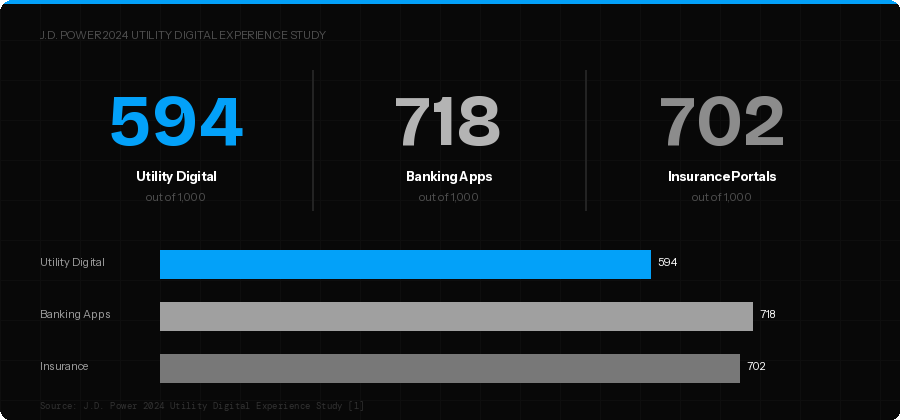
The gap between expectation and experience is measurable. J.D. Power’s 2024 Utility Digital Experience Study found that customer satisfaction with utility websites and apps averages just 594 out of 1,000, compared to 718 for banking apps and 702 for insurance portals[1]. At the same time, E Source reports that 67% of customers prefer self-service for routine transactions[2]. The expectation is clear, but preference alone does not equal readiness.
Research from McKinsey shows that organizations delivering superior digital experiences see two to three times higher engagement in their programs[3]. For utilities, that engagement isn’t a vanity metric. It determines whether customers enroll in demand response, respond to conservation signals, or rely on digital alerts during outages.
And customer expectations are rising alongside the energy transition itself. EY’s global consumer research shows that customers increasingly expect real-time digital insights, personalized recommendations, and transparent communication from their energy providers as electrification accelerates[4]. In other words, participation in the energy system is becoming digital by default.
This isn’t about polishing a portal or keeping up with design trends. It’s about infrastructure.
If your portal is intuitive, reliable, and trusted, it becomes a response channel during outages. It helps you stabilize demand during peak events. It enables participation in pricing signals and demand-side programs. But if it’s confusing, inconsistent, or rarely used, it becomes a liability—technically available, but operationally irrelevant.
User experience is now part of your resilience architecture.
If customers can’t navigate your platform quickly and confidently, they won’t rely on it when urgency strikes. And if they don’t rely on it, your ability to communicate, influence demand, and maintain trust under pressure is limited.
The question is no longer whether you have a portal, because that is not optional anymore. The question is whether it performs when your systems are under stress.
The Anatomy of Great UX
The best digital platforms rest on five pillars. Each is rooted in behavioral science and proven in industries that customers interact with every day. Utilities that embrace these principles can transform their portals from passive bill-pay sites into resilient engagement engines that meet regulatory demands and customer expectations.
Ease-of-Use: Remove the Roadblocks
When conditions are normal, friction is an annoyance.
When conditions are tight, friction is a liability.
Behavioral science tells us that the more steps you add, the slower decisions become. Hick’s Law shows that decision time increases as choices multiply. The “paradox of choice” shows that too many options create hesitation and abandonment. In most industries, that leads to lost conversions. In energy, it leads to something more serious: delayed action during moments when timing matters.
Think about what happens during a storm. A customer tries to report an outage but encounters multiple screens, unclear buttons, or a password reset loop. Each extra click increases the chance they give up and call instead. Now multiply that friction across thousands of households. Call queues grow. Costs spike. Frustration spreads. And your digital channel, which should be relieving pressure, becomes irrelevant.
The same pattern plays out with rate changes, assistance enrollments, or peak-demand alerts. If customers have to think too hard about what to do next, many won’t do anything at all.
Ease-of-use is not about aesthetics. It’s about speed to clarity.
Banking apps have reduced complex transactions to a few taps. Insurance portals guide customers step-by-step through detailed claims. They’ve learned that simplicity builds confidence and confidence drives action.
For you, the standard is even higher. Regulators expect timely communication during emergencies. Customers expect transparency in billing. If your portal requires effort to interpret, you increase the likelihood of delayed response, escalated complaints, and avoidable call volume.
When your digital experience feels simple, customers use it more often. And when they use it more often, it becomes familiar. Familiarity builds trust. And trust determines whether they rely on you when stress hits.
Ease-of-use is not about making your portal look modern. It’s about ensuring your customers can act quickly and confidently when it matters most.
Design Quality: Make It Effortless
Ease-of-use removes steps.
Design quality removes doubt.
When your customers open your portal, they’re not just looking for information. They’re looking for confirmation that they’re in control. Clear structure, logical layout, and consistent visual cues tell them they’re in the right place and can move forward confidently.
Cognitive psychology shows that people rely on patterns to reduce mental effort. When layouts are cluttered, navigation shifts between screens, or terminology changes from page to page, the brain has to work harder. That extra effort slows decision-making. Under normal conditions, that may just mean mild frustration, but under stress, it means hesitation.
Think about a high bill moment. If charges are buried in dense tables or unclear categories, customers don’t feel informed, so they feel uncertain. Or consider an outage map during a major storm. If status updates are visually inconsistent or difficult to interpret, customers question whether the information is reliable. Once doubt creeps in, trust erodes.
Design quality is not decoration. It is cognitive guidance.
Strong digital platforms create visual hierarchy, so the most important information stands out immediately. They use consistent language and iconography so customers don’t have to relearn the interface every time they log in. They eliminate clutter so critical updates or alerts are unmistakable.
Banks treat design quality as a signal of reliability. Fitness apps use clean interfaces to motivate daily engagement. For you, design quality carries even greater weight. During storms, billing changes, or demand events, your portal becomes a public-facing representation of your operational competence.
If the experience feels chaotic, customers assume the organization behind it is chaotic. If it feels clear and composed, they are more likely to trust the information you provide and act on it.
When customers can absorb information at a glance, they move from confusion to confidence faster. And confidence is what allows them to act quickly when the moment demands it.
Accessibility: Trust Through Inclusion
Resilience only works if everyone can participate.
If parts of your customer base can’t reliably access your digital tools, your resilience strategy has blind spots. And blind spots become liabilities during outages, peak demand events, and billing disruptions.
Accessibility is often framed as a compliance issue. And it is true that digital accessibility is required under the Americans with Disabilities Act (ADA), with updated guidance from the U.S. Department of Justice clarifying expectations for state and local government digital properties[8]. Regulators are paying closer attention, and noncompliance carries legal and reputational risk.
But accessibility is more than compliance. It’s reach.
During storms, vulnerable populations rely disproportionately on digital updates. Elderly residents may depend on larger text interfaces. Customers with limited English proficiency need alerts in their primary language. Customers using assistive technologies require screen reader compatibility and predictable navigation. If those systems fail, you don’t just risk dissatisfaction; you risk excluding the very customers who may need information most urgently.
When customers encounter barriers, they question whether the system was designed with them in mind. That doubt doesn’t disappear after the event ends.
Leading financial institutions have invested heavily in accessibility not only to meet oversight expectations, but to broaden adoption and strengthen trust. For you, the implications are even more significant. During peak demand events or extended outages, accessibility determines who receives restoration updates, pricing signals, and conservation requests in time to act.
When accessibility is embedded into your digital platform, you expand the number of customers who can participate in demand response, enroll in assistance programs, and act on outage alerts. That expands your operational flexibility.
Consistency: Match the Trust Patterns Customers Rely On
Your customers don’t reset their expectations when they open your portal.
They bring with them the experience patterns they rely on from digital experiences with other consumer brands. They expect to get what they get elsewhere when their money is on the line, time is short, or uncertainty is high: clear status, predictable navigation, immediate confirmation, and updates that don’t contradict each other.
Your customers trust these patterns for a simple reason; they reduce uncertainty. When a system consistently shows what’s happening, what changed, and what to do next, people don’t have to guess. Over time, that predictability becomes a shortcut for trust. The experience feels stable and stability is what people look for when they’re under pressure.
Behavioral science calls this anchoring bias. Once customers become accustomed to clarity and consistency in one context, they expect it everywhere. If your portal behaves differently (inconsistent layouts, disconnected mobile and web experiences, or information that changes from alert to dashboard) customers don’t interpret that as “industry variation.” They interpret it as unreliability, which weakens resilience.
During routine moments, inconsistency is inconvenient. During outages or peak demand events, it becomes destabilizing. If an alert doesn’t match what customers see when they log in, if restoration estimates shift without explanation, or if pricing signals arrive without confirmation, hesitation increases. And hesitation under pressure pushes customers to the channel they trust most: your call center.
Consistency signals control.
When these patterns are present, customers don’t have to think about whether they can rely on your platform. They simply do.
Delight: Build the Habit
Behavioral psychology shows that repeated positive reinforcement turns occasional behavior into routine behavior. When an action consistently produces a clear, reassuring outcome, your customers begin to expect that reliability. Over time, expectation becomes habit.
And habit is what turns digital access into digital readiness.
If a customer only visits your portal once a year to pay a bill, your digital channel is transactional. But if they receive useful alerts, see timely confirmations, and experience small moments of clarity and progress throughout the year, the platform becomes familiar. Familiarity reduces hesitation. Reduced hesitation increases response.
That is how resilience is built long before a crisis. Every accurate update reinforces trust. Every immediate payment confirmation reduces anxiety. And every clear conservation signal followed by visible feedback strengthens credibility. These moments are small, but they compound.
Over time, customers stop asking whether your digital channel will work. They assume it will. And that assumption is powerful.
When a peak demand event or major storm hits, response speed depends on familiarity. Customers are far more likely to act quickly on an alert if responding digitally already feels routine.
Regulators evaluate participation in efficiency and demand response programs. Habitual digital engagement improves those outcomes through repetition and reliability.
Delight does not mean entertainment. It means creating digital experiences customers trust enough to return to regularly. And repetition is what transforms a portal from a tool into part of your resilience infrastructure.
Why UX Matters for Resilience
Resilience is no longer defined solely by how quickly you restore power. It is defined by how effectively you mobilize customers when conditions tighten.
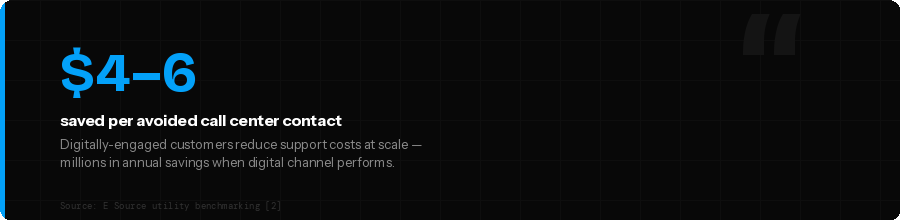
An intuitive digital experience allows customers to report outages online, enroll in alerts without friction, and manage bills before they escalate. That reduces strain on staff, lowers cost-to-serve, and supports compliance with storm-response and communication requirements. Each avoided call saves $4–6[2]. At scale, that translates into millions in operational savings, and regulators notice those efficiencies during rate reviews.
But the absence of digital resilience is just as measurable.
When customers cannot rely on digital updates during storms, they call. Call queues grow. Costs rise. Frustration spreads. Delayed or inconsistent information erodes trust and increases scrutiny from regulators and local media. In competitive markets, friction accelerates churn. Internally, teams divert time toward manual fixes instead of proactive engagement.
Digital experience is not a branding layer. It is operational infrastructure and real-world examples illustrate the difference.
One large electric utility in the South-Central U.S. struggled with fragmented systems and no mobile channel. Customers encountered confusing workflows, and call centers were overwhelmed during peak events. After modernizing its customer engagement platform, the utility reduced workforce strain, improved response times, and increased digital adoption, strengthening resilience by aligning operations with customer behavior[6].
The impact becomes even clearer during extreme weather. During Hurricane Ian, Kissimmee Utility Authority avoided more than 2,500 calls in a single month by empowering customers with digital self-service tools. Outage alerts, online payment arrangements, and transparent updates allowed customers to stay informed without overwhelming support channels[7].

The pattern is consistent.
When digital channels are clear, reliable, and habit-forming, customers act digitally first. When they are confusing or inconsistent, customers default to high-cost channels at the exact moment pressure is highest.
Resilience is not only about restoring service. It is about preserving stability under stress and your user experience determines whether your digital channel absorbs pressure or amplifies it.
Where Utilities Fall Short
Despite years of investment in digital platforms, many utilities still struggle to convert capability into confidence. The breakdown rarely happens in one dramatic failure, but in small friction points that compound over time.
The first breakdown often occurs at the front door: login.
Multi-step registrations. Password reset loops. Confusing error messages. Customers abandon the process before they ever reach the value inside. Each abandoned session reinforces a simple belief: the digital channel is not worth the effort.
Then comes the second gap: information without guidance.
Customers see kilowatt-hours, line items, and usage charts, but no clear direction. What should they do differently? Should they enroll in budget billing? Shift usage? Respond to a pricing signal? Without contextual guidance, data becomes noise. And noise reduces action.
Personalization is another common gap. Customers increasingly expect relevant insights and proactive communication. Yet many utilities still rely on generic alerts and mass messaging. Without relevance, engagement remains shallow. Without engagement, trust never deepens.
Accessibility gaps persist as well. Inconsistent mobile experiences, limited language support, or incompatibility with assistive technologies create barriers that quietly exclude portions of your customer base. During routine months, those barriers may go unnoticed. During storms or peak demand events, they become operational blind spots.
What makes these gaps particularly risky is that they are subtle. The portal works, the data loads, and alerts go out. But customers don’t rely on it.
Some utilities are beginning to close these gaps. Advanced segmentation and behavioral design improvements have led to measurable increases in digital adoption and self-service utilization[5]. Others have modernized customer engagement systems to reduce call center strain and improve response during high-pressure events[6].
The difference is not the presence of technology. It is the alignment of experience with behavior.
When friction is reduced, guidance is clear, relevance is high, and access is inclusive, customers move digitally first. When those elements are missing, they default to the most familiar channel, which is typically a call.
Designing for Trust and Delight
Trust and delight are not separate from resilience. Instead, they are how resilience is built.
Trust is earned through consistency, transparency, and follow-through. When outage ETAs are accurate, bill breakdowns are clear, and confirmations are immediate, customers begin to rely on your digital channel as a stable source of truth. That reliability reduces anxiety and lowers the likelihood they escalate issues to higher-cost channels.
Delight strengthens that trust by reinforcing behavior.
When customers see that responding to an alert leads to a tangible outcome (a visible savings impact, a confirmed thermostat adjustment, or a smooth enrollment) they internalize that the system works. That reinforcement builds confidence not just in the platform, but in the provider behind it.
This is where many digital strategies fall short. They focus on adding features rather than shaping behavior. A feature may improve capability, but reinforcement improves reliability of response.
Designing for Predictable Participation
Resilience does not depend on access alone. It depends on response.
Your digital channel exists to support action, not just to display information. During routine moments, that action may be simple: reviewing a bill, enrolling in alerts, adjusting preferences. During high-stress moments, it may be critical: shifting load, reporting outages, responding to conservation signals.
In both cases, what matters is consistency.
Predictable participation happens when customers understand what to do, trust that the action will work, and have experienced that reliability before.
Behavioral science helps explain why.
When next steps are clear, customers move quickly. When choices are overwhelming or poorly framed, hesitation increases. In normal conditions, hesitation reduces enrollment. Under stress, it reduces response, and response time is what resilience depends on.
Context reinforces confidence. When usage, alerts, or pricing signals are presented with meaningful benchmarks (prior months, neighborhood averages, stated thresholds) customers can interpret what they’re seeing without guesswork. That clarity strengthens trust and aligns with storm-response communication best practices, where clarity and consistency reduce uncertainty under pressure [9].
Framing shapes urgency. Customers are more motivated to avoid losses than to pursue equivalent gains. Messaging that emphasizes preventing unexpected bill spikes or avoiding service disruption often generates stronger response than abstract savings language. How you communicate participation influences how reliably customers act.
And repetition builds stability. When actions are consistently confirmed, progress is visible, and follow-through matches expectation, customers stop questioning the channel. Engagement becomes routine. Routine becomes reliance.
That reliance is what transforms digital engagement into operational flexibility.
Predictable participation is not about persuasion. It is about reducing friction, reinforcing clarity, and building enough repetition that response becomes instinctive.
Closing Vision
User experience is not a cosmetic layer on top of your digital channel. It is the operating system that determines whether your strategy works under pressure.
When UX is treated with the same rigor as reliability planning, your digital channel becomes more than a communication tool. It becomes a response system. It reduces hesitation during outages. It increases participation during peak events. It strengthens trust when conditions are uncertain.
Without that discipline, even well-funded digital investments underperform. Customers may have access to tools, but access does not guarantee action. Clarity, consistency, and reinforcement do.
The next decade will test grid flexibility in new ways. Electrification, AI-driven load growth, and extreme weather are narrowing the margin between supply and demand. In that environment, resilience will depend not only on infrastructure, but on whether customers can respond predictably when asked.
User experience determines whether they can.
When your digital channel supports clarity, trust, and habitual participation, it strengthens your operational posture. It improves program performance. It reduces avoidable strain. And it demonstrates to regulators that digital engagement is managed with the seriousness resilience now demands.
UX is not merely a design initiative; it’s resilience discipline. And those who treat it that way will be the ones best prepared for what comes next.
